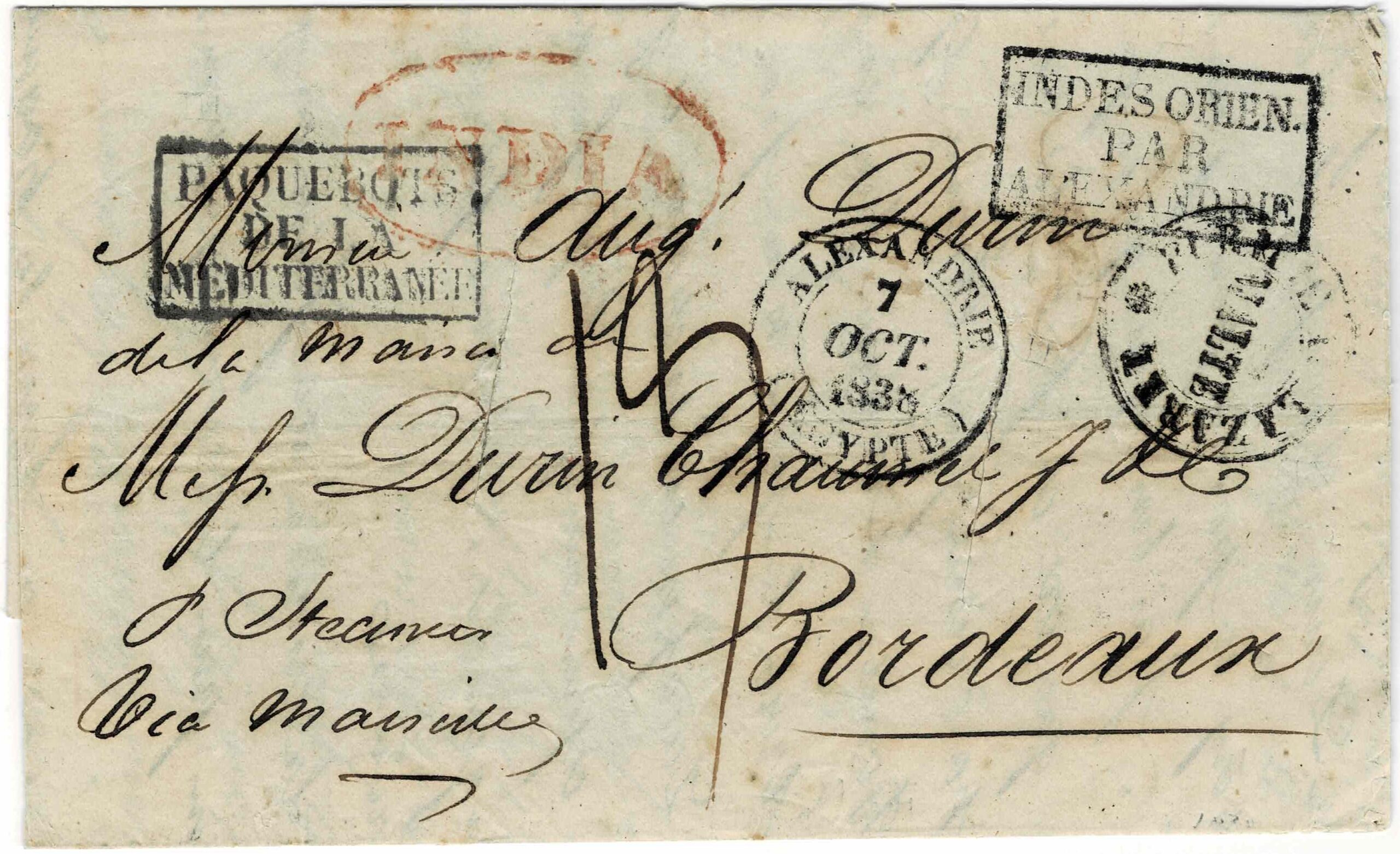
The 1830s and 1840s were exciting times for mails sent across the seas and oceans. These two decades saw a rapid transition in the carriage of letters from sailing ships (wind-assisted) to steamships (coal-assisted though they did have sails as an additional source of propulsion if needed).
This meant that mails could be carried regularly adhering to fixed schedules since ships no longer had to depend on when and how favourably the winds blew. Further, mails could be carried quicker since steamers were usually faster than their sailing cousins.
The first steamship to carry mails from India to the Red Sea so that they could be sent overland across Egypt and then through the Mediterranean to Europe was the East India Company’s (EIC) Hugh Lindsay. Leaving Bombay on 20 March 1830, she possibly carried mails on her first journey; however, no letters are known from that voyage.
In the coming years, EIC steamers made just a few voyages until they started doing so on a regular (monthly) contracted basis from mid-1837.
French Steamers in Mediterranean
Prior to the involvement of the French government, certain private companies2 such as the Compagnie Bazin run by the Bazin Brothers of Marseilles operated steam packets between Marseilles and Naples. The problem was that they operated on a small scale and did not have the financial strength to run regular services beyond Italy.
Read more here: